
Extended Distance PoE

What is PoE?
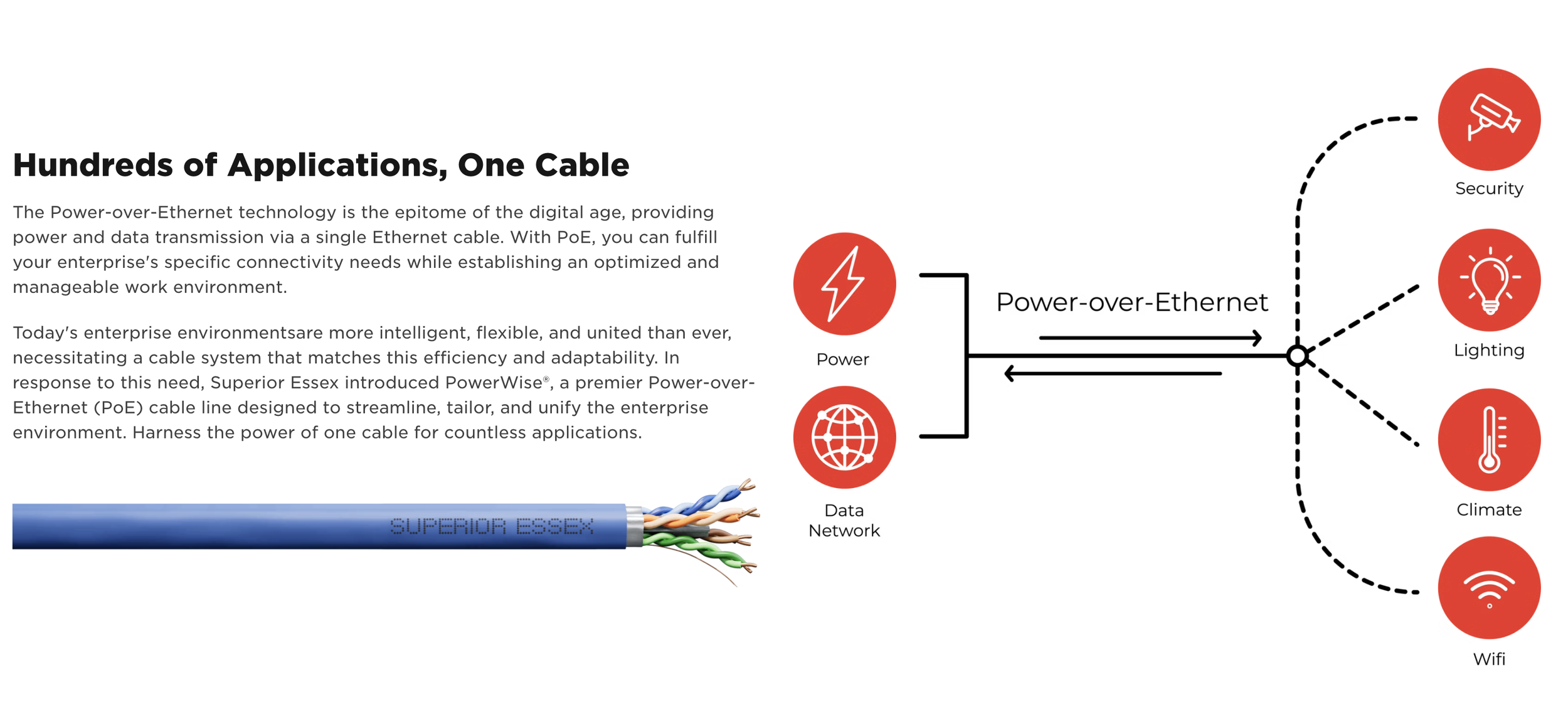
PoE, which stands for Power-over-Ethernet, represents a breakthrough in technology. It merges power transmission and data delivery via a single Ethernet cable. With the increasing demand for Internet of Things (IoT) devices. Many IoT devices are small and may need their power source, making PoE the perfect solution.
What "Extended Distance" Means in Structured Cabling
Every structured cabling project eventually runs into the same limit: TIA standards cap a permanent link at 90 meters and a channel at 100 meters. Those numbers exist so that every component in a system — cable, connectors, patch cords — is guaranteed to work together predictably, regardless of manufacturer. In the real world, though, building layouts don't always cooperate. Long hallways, large warehouses, outdoor camera runs, and distributed antenna deployments frequently call for cable runs well beyond that 100-meter mark.
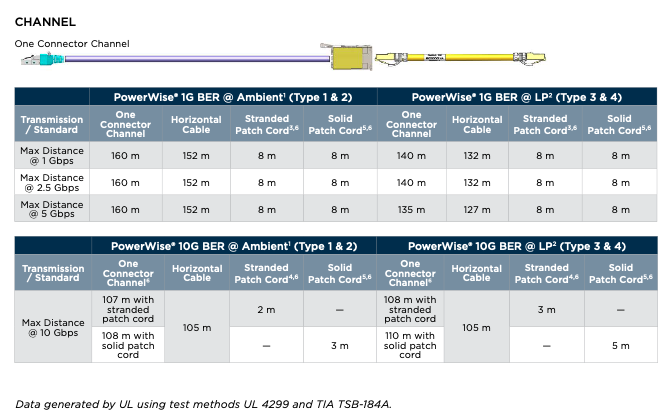
This is where the industry conversation around "extended distance" or "long-reach" PoE cabling comes in. It's not a workaround or a loophole — it's a recognition that when the right variables (cable construction, PoE type, connector count, ambient temperature, and bundle size) are properly balanced, a system can be engineered to perform reliably past the standard limit. The key word is engineered. Extended reach is a deliberate design decision for a specific application, not a general-purpose or "future-proof" default.
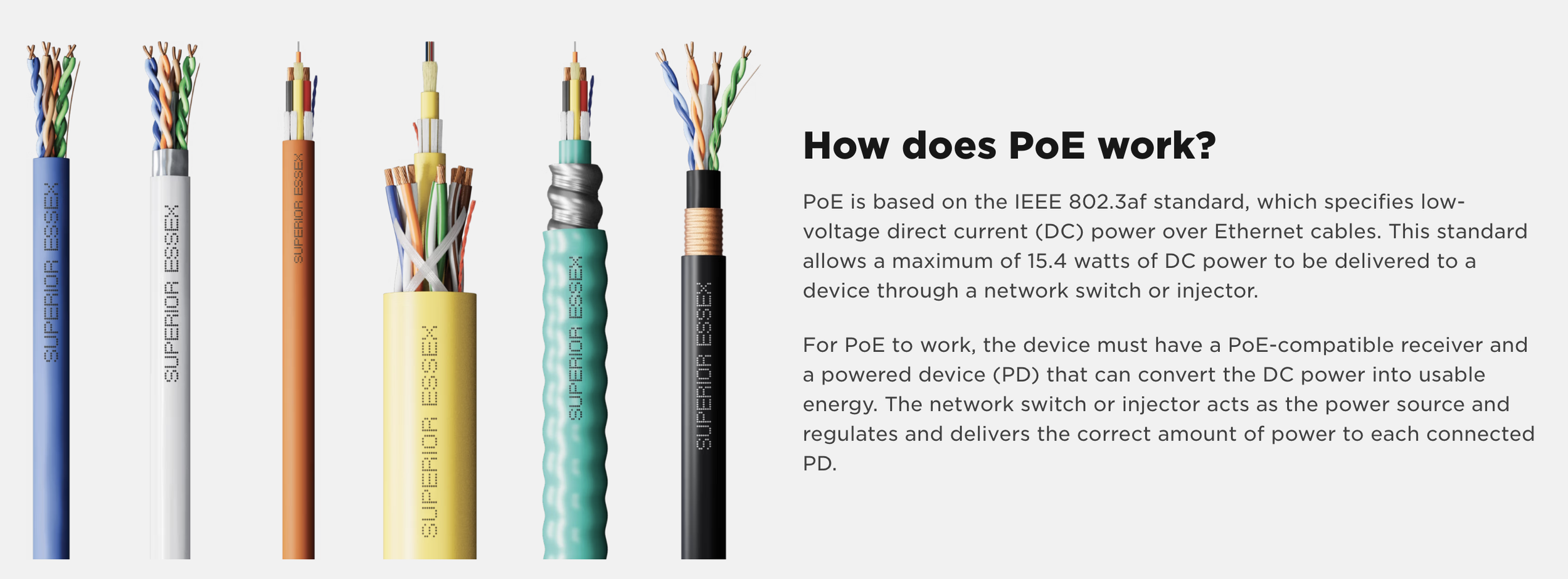
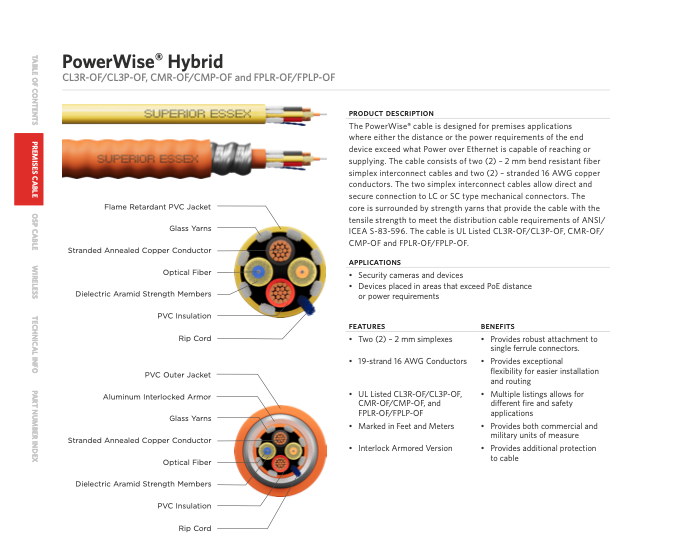
Superior Essex addresses this need with its PowerWise® product line, which includes both extended-distance 4-pair copper data cable and PowerWise hybrid fiber/copper cable. The copper data cables carry both power and data over extended runs; the hybrid cables take a different approach, using fiber for data and dedicating their copper conductors purely to power delivery, with reach determined by voltage-drop calculations rather than data performance.

Frequently Asked Questions
Q: Are extended-distance-rated cables still category rated?
A: Category ratings (Cat 5e/6/6A, etc.) are defined by electrical performance up to the standard TIA length limits — 90m permanent link or 100m channel. Beyond that, category rating simply doesn't apply, since it was never tested or defined for those lengths. A cable's "Verified" category marking (by UL, ETL, etc.) only reflects performance within standard-length applications.
Q: Does a 10G-rated cable support longer extended-distance runs than a 1G-rated cable?
A: Counterintuitively, no — 10G cable typically supports shorter extended runs. Cables engineered for 10G applications use tighter conductor twists to manage crosstalk at higher frequencies, and those higher frequencies attenuate faster over distance. A more loosely twisted, 1G-oriented cable construction actually favors longer reach.
Q: What connectors are needed for termination?
A: Most standard 8P8C (RJ45) modular plugs are compatible, since they're built to accommodate the 22–26 AWG conductor range these cables use. It's still worth checking manufacturer compatibility guides and warranty terms for approved connector types, especially for outdoor or specialty installations.
Q: What environments support extended-distance deployment?
A: Extended-distance cable is available across premises, outside-plant (OSP), and indoor/outdoor rated constructions. Matching the cable's temperature rating to the worst-case ambient environment is an important part of product selection, not just distance planning.
Q: What PoE types should I know about?
A: PoE has evolved through several IEEE standards — commonly referred to in the field as PoE, PoE+, and 4PPoE/PoE++ (or UPoE/Hi-PoE), each stepping up in power delivery. Extended-distance performance is typically documented separately for each PoE class, since higher power draw affects heat and voltage drop over long runs.
Q: How do I figure out the power and data requirements of the end device I'm connecting?
A: Check the manufacturer's spec sheet for the device — power requirements are usually listed under "Power" or "Environmental and Electrical" and given in watts (use the "max" figure, not typical). Data/bandwidth requirements are usually under "Network," in Mbps or Gbps. Note that a camera's megapixel count is not a reliable indicator of its bandwidth needs — always check the actual network specification.
Still have questions? Reach out to us!